Edge AI for PPE: from a camera frame to the supervisor’s inbox, without anyone asking
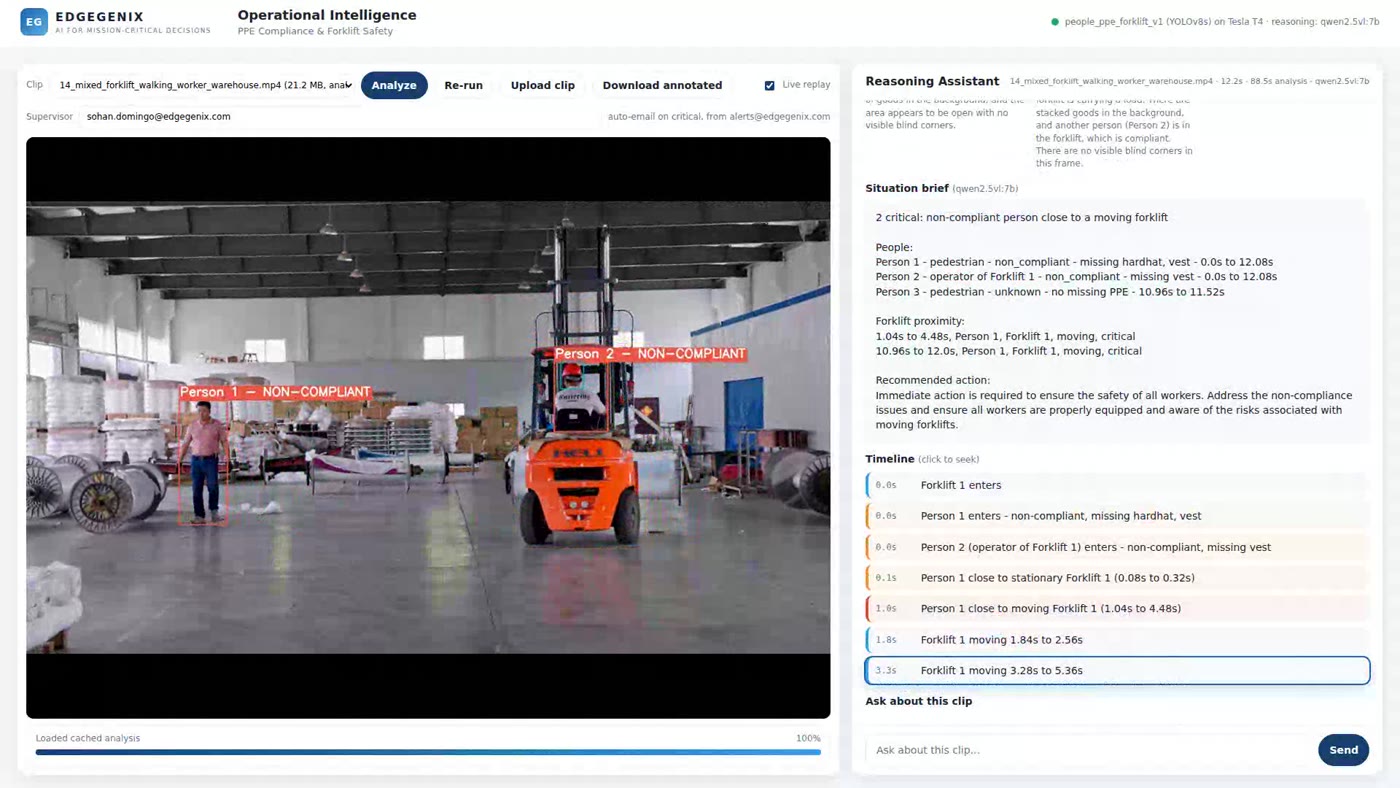
A worker in a pink polo walks past a moving forklift. No hard hat, no hi-vis vest. Twelve seconds later the site supervisor has an email with a clip of it. Nobody pressed a button.
Most “AI safety camera” demos end with a bounding box. A person is drawn in green or red, and the audience is left to imagine the rest. The rest is the hard part: deciding whether the red box matters, explaining why, and getting it to the one person who can do something about it, before they’ve moved on.
This post shows a short clip from our PPE compliance and forklift safety console, and walks through what happens between the frame and the inbox.
The walker and the forklift
Recorded from the console · 40 seconds · the clip, the verdict, the events as they land, and the email that went out
What you’re watching, left to right:
- Left pane. The warehouse clip with the system’s own overlay. Person 1, the walker, is boxed red and labelled non-compliant. Person 2, the forklift operator, is also red, but for a different reason: hard hat on, no vest. The forklift is labelled, and the label changes to “moving” when it is.
- Right pane, top. The verdict for the whole clip, decided before you press play: 2 critical: non-compliant person close to a moving forklift.
- Right pane, as the clip plays. Rows appear at the moment they happen. At one second, “Person 1 close to moving Forklift 1” turns red. Under it, a green card slides in: the supervisor has been emailed, with the subject line, the time, and the 15-second clip that went out as the attachment.
- The end of the recording is the email itself, as the supervisor received it. Verdict, the people involved, what each is missing, a plain-language brief, and the clip playing.
One thing worth noticing: the console never asked a question. The chat box at the bottom is there for follow-ups (“what should the supervisor do first?”), but every finding on screen was surfaced by the system on its own. That is the difference between a safety tool and a chatbot with a camera attached.
What happens in between
Four stages, and only two of them involve a model.
Two detectors look at every frame
A general-purpose person detector finds people and follows each one through the clip, so “Person 1” at second one is the same Person 1 at second eleven. A specialist model, trained on PPE and forklifts, finds hard hats, hi-vis vests, and the truck.
We split the job on purpose. A PPE model trained mostly on workers wearing PPE turns out to be weakest at spotting the person who isn’t — which is exactly the person you’re looking for. The general detector doesn’t have that blind spot.
No model decides anything here
A short, readable set of site rules does: compliant means hard hat and vest; a person whose box sits inside the forklift’s for most of the clip is the operator, not a pedestrian; the forklift is moving when it shifts or changes size over a one-second window; a pedestrian is “close” when the gap is under six-tenths of a forklift length, and they’re at the same depth in the scene.
Severity follows from those facts. Critical is reserved for one combination: a non-compliant pedestrian near a forklift that is actually moving.
Because the rules are code, a safety manager can read them, argue with them, and change them for a site without retraining anything.
A vision-language model in the cloud, doing two narrow jobs
The events and the cropped stills the edge produced sync up to Edgegenix Cloud AI, where a vision-language model looks closely at each person and answers a strict question: is that a rigid hard hat or a beanie, a fluorescent vest or a dark jacket? It also writes the situation brief and answers follow-up questions, working only from the event list the rules produced.
It reports the verdicts. It never re-judges them.
One action, automatically
A critical event escalates on its own: the edge cuts a short clip around the moment, and Cloud AI emails the supervisor with the verdict, the brief, a still, and the clip. Warnings on their own don’t email anyone.
That threshold is deliberate. A system that emails on everything gets switched off.
Where each part runs
Seeing and deciding happen at the edge. The detectors and the rules run on the asset, next to the cameras. No continuous video stream leaves the site. What leaves is a few kilobytes of events — who, what was missing, when, how close — plus a still and, on a critical event, a short clip attached as evidence.
That split is the point. Inference where the camera is means no round trip, no dependence on a link that may be down, no bandwidth bill for a continuous video river, and footage of people at work that stays on site by default.
The intelligence sits in the cloud. Those events sync up into Edgegenix Cloud AI: the reasoning that turns an event list into a plain-language brief, the history across shifts and sites, the thresholds and who gets told when one is crossed, and the evidence trail behind every finding.
And it is watched in a console built for this job. What you saw in the clip is the dedicated PPE compliance and forklift safety view — the clip with its overlay, the verdict, the timeline of events as they land, the email that went out, and a box for follow-up questions. A supervisor opens one page, not five.
The vision stage is designed for the class of edge accelerators we deploy on poles and in cabinets — the same Edgegenix Edge AI core that runs fire and smoke detection. The rules cost nothing. The reasoning lives in Cloud AI, where it can be improved without touching a single device in the field.
PPE compliance and forklift safety is one module on the Edgegenix platform — the same edge core that runs fire and smoke detection, intrusion and asset inspection, against the cameras a site already operates.
Run it on your own footage.
Send us a few minutes from one of your cameras and we’ll run it through the same console — your site, your rules, your thresholds. Thirty minutes, no obligation.