Detecting smoke is the easy part
Any smoke detector worth the name will find a plume. The question a duty officer actually has to answer is the next one — is it worth sending a truck? So we run two models, not one. A detector finds the smoke; a vision-language model is then asked, in plain words, whether there is really a flame there. Here is what happened when the two disagreed.
The two models
| The model | What it does | How often it runs |
|---|---|---|
| The detector | Draws a box around smoke and around fire in every frame, with a confidence score. Fast, cheap, and it has no idea what it is looking at — only that the shape matches. | Every frame, continuously, on the device |
| The reasoner | Receives the crops the detector flagged as fire and answers in words: is there a visible flame, and what is this object? Slower and more expensive by comparison. | Only on flagged crops, a handful per clip |
That split is the whole design. The detector gives you frame-rate coverage. The vision-language model gives you a judgement a person can read, on the small number of frames where a decision is actually at stake.
What you are looking at
Two clips from a field test this month, flown over a public reserve under CASA rules with a licensed operator, inside visual line of sight and clear of people on the ground. The smoke is from canisters. The flame in the first clip is a small burn contained in a metal drum, on mown grass, on a still day, with extinguishers and a water supply standing by and the site checked before anything was lit. None of that is the interesting part, but a fire officer will ask, so there it is.
Who ran it
The trial was a joint effort between three parties, and it is worth naming them because none of us could have run it alone.
Sohan Domingo
Brought the detection and reasoning pipeline, and the operational intelligence console you can see running in both clips.
Harrison Su
Caelvox provides modular, multimodal industrial inspection and asset intelligence solutions — the sensing and inspection side of the problem this pipeline sits on top of.
Laurens Willems van Beveren
ADS is a ReOC accredited drone operator, building a network of drone suppliers, professionals and customers.
Clip one: smoke, then a flame, then a decision
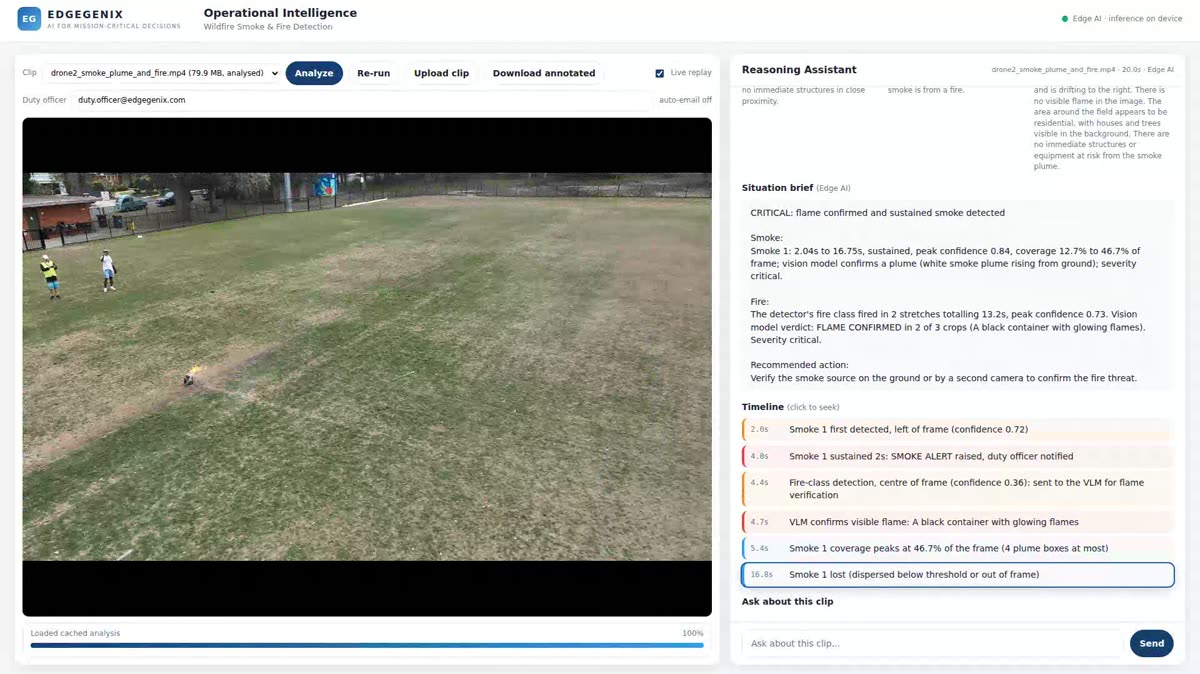
Left: the drone feed with live detections. Right: the Reasoning Assistant, writing the situation brief as the clip runs.
The console records the sequence second by second. Smoke is first detected at 2.0s, left of frame, at 0.72 confidence. Nothing is raised yet — the detector has to hold it for two full seconds first, which is what stops a gust of dust from paging anyone. At 4.0s the smoke alert goes up and the duty officer is notified.
At 4.4s the detector first fires a fire class in the centre of frame, and weakly: 0.36. That reading is what sends the crop to the vision-language model, and at 4.7s the answer comes back — a black container with glowing flames. Flame confirmed in two of three crops, and the brief is upgraded to critical. Over the whole clip the fire class fires in two stretches totalling 13.2s and peaks at 0.73.
Every figure on this page is printed on screen in the footage. Pause the clip and check.
Worth noting what the system then recommends. Not “dispatch”, but verify the smoke source on the ground or by a second camera to confirm the fire threat.
Clip two: the one we care about
Dense smoke, a critical brief, and a fire alarm raised by the detector and then shut down by the second model.
Same setup, no fire. A canister throws a dense plume, and the detector also fires its fire class — one unbroken stretch of 12.0s, peaking at 0.62. Put that beside clip one, where there really was a flame: two stretches totalling 13.2s, peaking at 0.73. Same shape, same duration, same confidence band. Nothing in the detector’s own output separates the fire from the canister, so on the detector alone this is a call-out and a crew turns out.
The crops go to the vision-language model instead, and come back no flame, four times out of four — an orange smoke canister. The fire alarm is suppressed and dropped to informational. The smoke verdict is left exactly as it was: smoke is still smoke, someone should still look. Nobody is told there is a fire, because there is no fire.
Where a drone doing this earns its keep
Confirm before the crews roll
California now runs 1,260 mountaintop cameras, 915 of them with AI that alerts dispatch before the first 911 call — more than 900 fires flagged that way on state lands. That is a verification queue no control room can keep an eye on. A drone that flies the coordinates and rules smoke in or out is the obvious next link.
Find the ignition before the tower can
NSW RFS ran a two-week trial in March 2024 over western NSW, near Cobar and Bourke, flying long-range drones with electro-optical and infrared cameras — four hours endurance, 50 km from the control station, approved for night work — to pick up heat signatures from lightning-caused fires.
Hotspots, at night
CFA now has 21 trained drone pilots and thermal-equipped aircraft. At the Rhyll fire on Phillip Island in January they found several hotspots outside the main fire, identified them at night, and guided crews in using the drone’s spotlight and radio while watching the image on screen.
Patrols nobody has to watch
Powerline corridors, rail reserves, plantation forestry, solar and wind farms, mines and landfills. Scheduled runs where the model flags smoke on its own, so there is no person staring at a feed waiting for something that usually never happens.
What we are building next
These clips were analysed after the flight, not during it. The drone flew, the footage came back, and the pipeline ran over it — which is the right way to test whether the two models disagree in the way you hoped, and the wrong way to help a crew in the air.
So the work in front of us is continuous analysis on a live feed, at frame rate, with the alert leaving the aircraft instead of the video. That is the version that changes a dispatch decision rather than explaining one afterwards. We would rather put the numbers in front of you when we have them than describe them now.
What these two clips do establish is narrower, and we think more useful: a second model, asked the right question, will reject a high-confidence false positive that a detector alone would have escalated — and leave a timeline you can read back afterwards.
Send us sixty seconds of your footage
Drone, fixed camera, dashcam — whatever you already have. We will run it through the same pipeline and send back the annotated clip and the brief, so you can see how it behaves on your conditions rather than ours.
Get in touchMore on how the detection layer runs on-device in Edge AI, and on the wider set of operations this platform covers in Solutions.