One platform, seven operations: what edge AI for critical infrastructure actually looks like
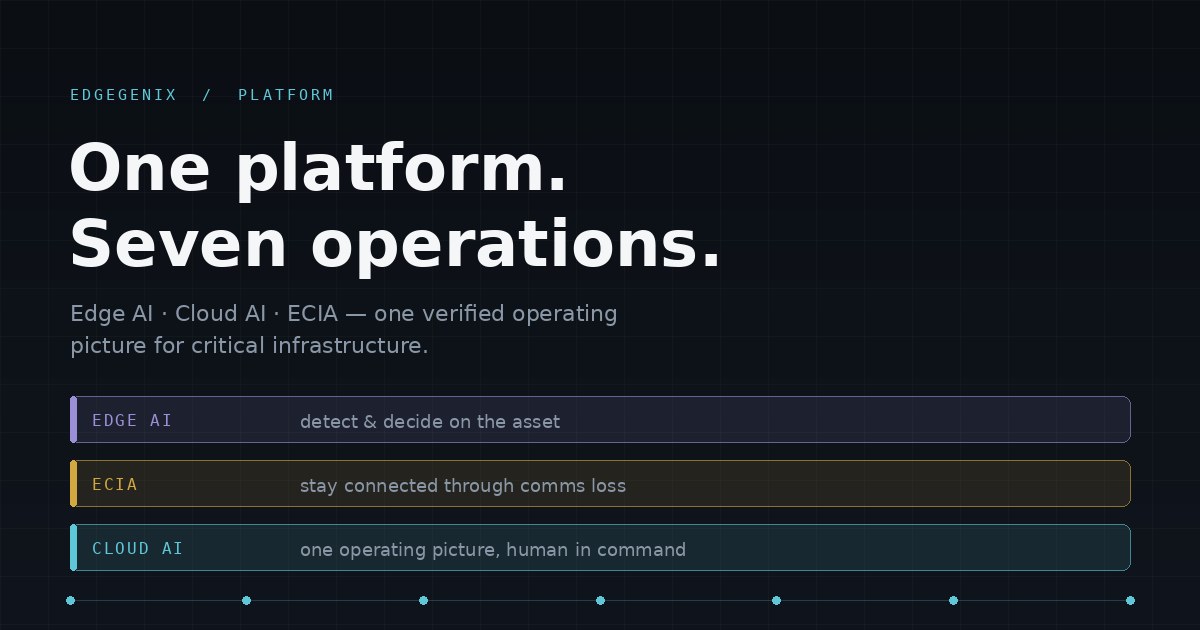
A golf course, a vineyard, a forestry estate, a school, an aged-care home, an emergency fleet, an unmanned grid site. Seven operations that look nothing alike — and underneath, the same problem, solved by the same platform.
It is tempting to think each of these industries needs its own bespoke system. In practice they don’t, because they all share one operating problem. Each of them already has the signal — a camera, a sensor, a thermal feed, a radio network. What they lack is the step in between: turning that signal into a decision someone can act on and defend, fast enough to matter, in places where the network is weak or gone.
That in-between step is the whole of what we build, and it has the same three parts everywhere.
Edge AI runs on the asset itself — a camera tower, a vehicle, a sensor on a wall — and makes the first call where the event happens, in real time, without waiting for a round trip to a server that may not be reachable. ECIA, our connectivity intelligence layer, keeps the operation working through comms loss: it store-and-forwards, chooses the path that is actually up, and reconciles what came in over which link. Cloud AI takes the verified findings and assembles them into one operating picture — a single, defensible view with the evidence trail attached, and a human always in command of what happens next.
Detect on the asset. Stay connected when the link drops. Verify in the operations centre. That is one platform. What changes from one industry to the next is only what the sensor is pointed at — and the cost of being a minute too late.
Camera, sensor, vehicle or tower — the first call is made on-device, in real time.
Store-and-forward and path selection keep the finding moving when the network doesn’t.
One defensible view of the event, with the evidence trail attached.
A human is always in command of what happens next.
A golf course is a large expanse of open ground with people spread across every hole and almost no cover. The operating risk is environmental and fast-moving — a lightning cell closing in, smoke drifting from a fire kilometres away — and the duty of care sits with a small team that cannot physically see the whole course at once. Edge AI on existing cameras and weather inputs watches the ground continuously and flags the developing hazard early; the operating picture tells the team where their people are relative to it, so the call to clear the course is made on evidence and minutes ahead, not on a glance at the sky. See the golf detail →
02 · VineyardsA vineyard does not need to burn to be ruined. Smoke drift from a distant fire can taint an entire vintage, and the window to respond — to decide on picking, netting or protective action — is measured in hours. The problem is knowing, early and specifically, that smoke is on the block at all. Edge AI on cameras across the estate detects smoke where it appears and puts it on the map with a confidence and a time, so the grower is acting on a verified reading rather than a rumour from the next valley. See the vineyard detail →
03 · ForestryForestry operations cover enormous areas of remote country where connectivity is thin and a person cannot be everywhere. Early detection of ignition, and awareness of where crews and machines are, is the difference between a contained event and a lost estate. This is edge territory by definition: detection has to happen on towers and assets in the field and survive the fact that the network out there is unreliable. ECIA carries the finding back through whatever link is available; Cloud AI holds the single picture. See the forestry detail →
04 · SchoolsA school at the bushland interface carries a decision no one wants to make late: whether and when to shelter or move hundreds of children. That decision needs early, trustworthy warning — not a wall of raw alerts, but a clear reading of what is developing and how confident the system is. Edge AI provides the early detection; the operating picture gives the people responsible one verified view to base the clearance decision on, with the record of why it was made. See the schools detail →
05 · Aged careEvacuating an aged-care facility is slow by nature — residents with limited mobility cannot be moved quickly — so the only way to make a safe evacuation possible is to start it earlier. That puts all the weight on warning time. The same edge-detection-plus-verified-picture pattern is what buys those extra minutes: an early, confident read of an approaching threat, delivered to the people who have to act, long enough before it arrives to matter. See the aged-care detail →
06 · Emergency & fleet communicationsAn emergency appliance or SES vehicle can carry several radio and data systems at once, and in the field the crew’s real question is simply whether any of them is currently getting through. This is the problem ECIA was built for: it sits across the available links, keeps messages moving by store-and-forward when a path drops, and gives the crew and the operations centre an honest picture of what connectivity they actually have. A decision made offline still reaches the people who need it once a link returns — nothing is lost. See the fleet-comms detail →
07 · Critical infrastructureSubstations, pump stations, remote grid and water assets sit unmanned for long stretches, and a fault, an intrusion or a fire can develop with no one there to see it. Edge AI turns the cameras and sensors already on those sites into a watch that never leaves — detecting the anomaly on the asset, in real time — and raises a verified event into the operating picture the moment it matters, rather than surfacing it in a log days later. See the infrastructure detail →
Lightning & drifting smoke on open ground → clear the course in time
Smoke on the block, no fire needed → act to protect the vintage
Ignition across remote estate → detect early, contain early
An approaching threat → one confident shelter-or-move decision
Early, trusted warning → start the slow evacuation sooner
Which links are actually up → keep the crew connected
Anomaly on an unmanned site → a verified alert, now not later
Line the seven up and the shared shape is obvious: a sensor feed becomes a decision at the point of capture, survives a network that may not be there, and lands as one trusted view with the evidence attached. Because the underlying problem is the same, the answer can be one platform rather than seven disconnected products — which matters, because a control room drowning in a dozen separate tools is exactly the failure mode we set out to remove.
It also means an organisation running more than one of these operations — a council with schools, fleets and infrastructure; an estate with forestry and fire exposure — gets one operating picture across all of them, not a new silo per problem. Australian-built, sovereign and air-gap capable, with a person always in command.
The platform is live today, and we’re onboarding a limited number of operations across these seven verticals ahead of the ANZ fire season. If you operate at the edge of the network — where the signal is already there but the decision still isn’t — that is exactly the gap we close.