When the link drops, the decision can’t: agentic AI at the edge for firefighters
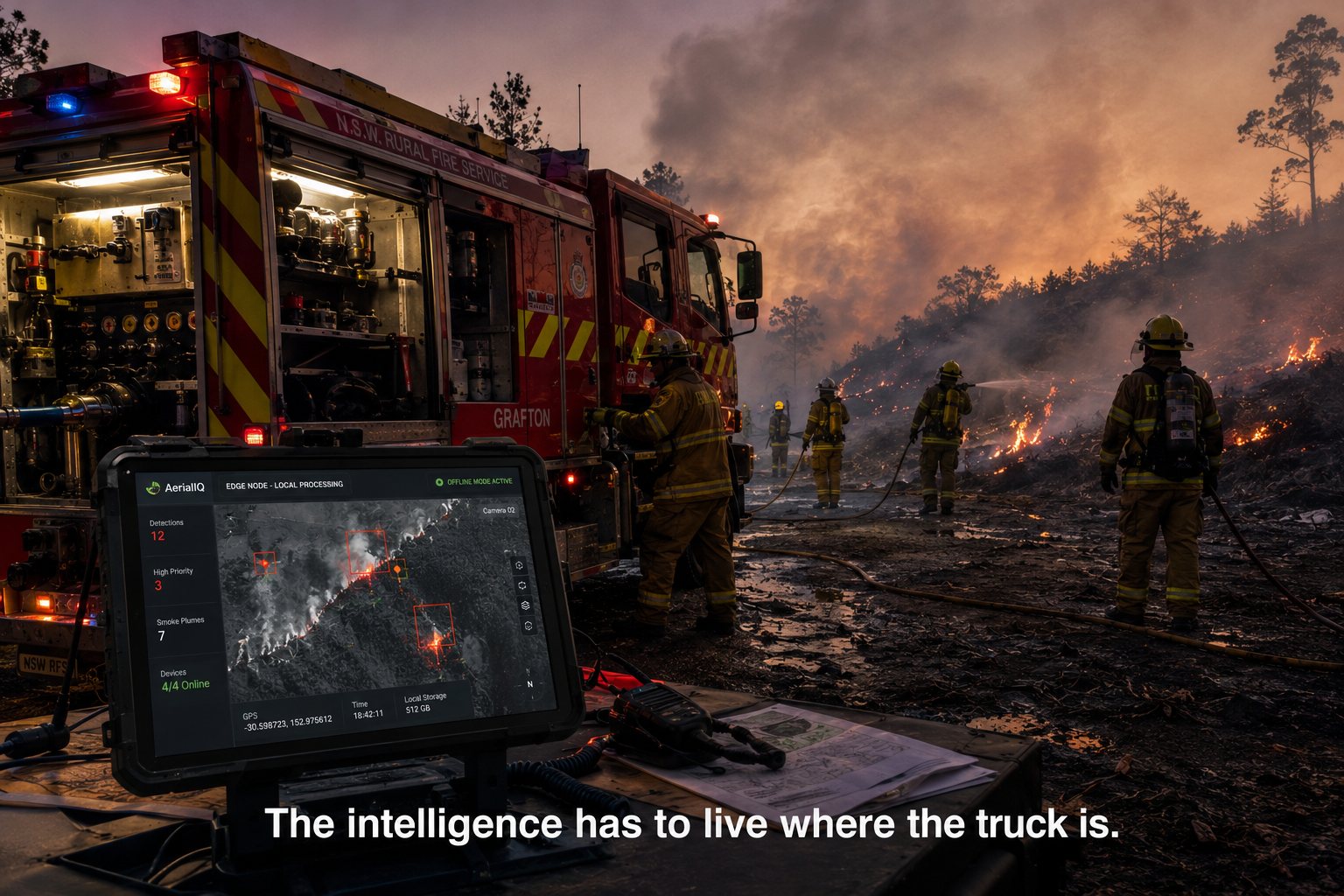
A technical use-case deep-dive on thermal + visual sensing, on-vehicle edge compute, and what actually has to happen on a major fire-ground — not just at the tower.
The moment the technology has to earn its place
On 30 December 2019, near the New South Wales–Victoria border, a sudden, violent wind change from a fire flipped a NSW Rural Fire Service truck. Sam McPaul was killed. Eleven days earlier, near Buxton south-west of Sydney, a falling tree struck another RFS truck and killed Geoffrey Keaton and Andrew O’Dwyer. They were among the four RFS members who died that Black Summer, alongside three American aircrew lost when their C-130 air tanker went down.
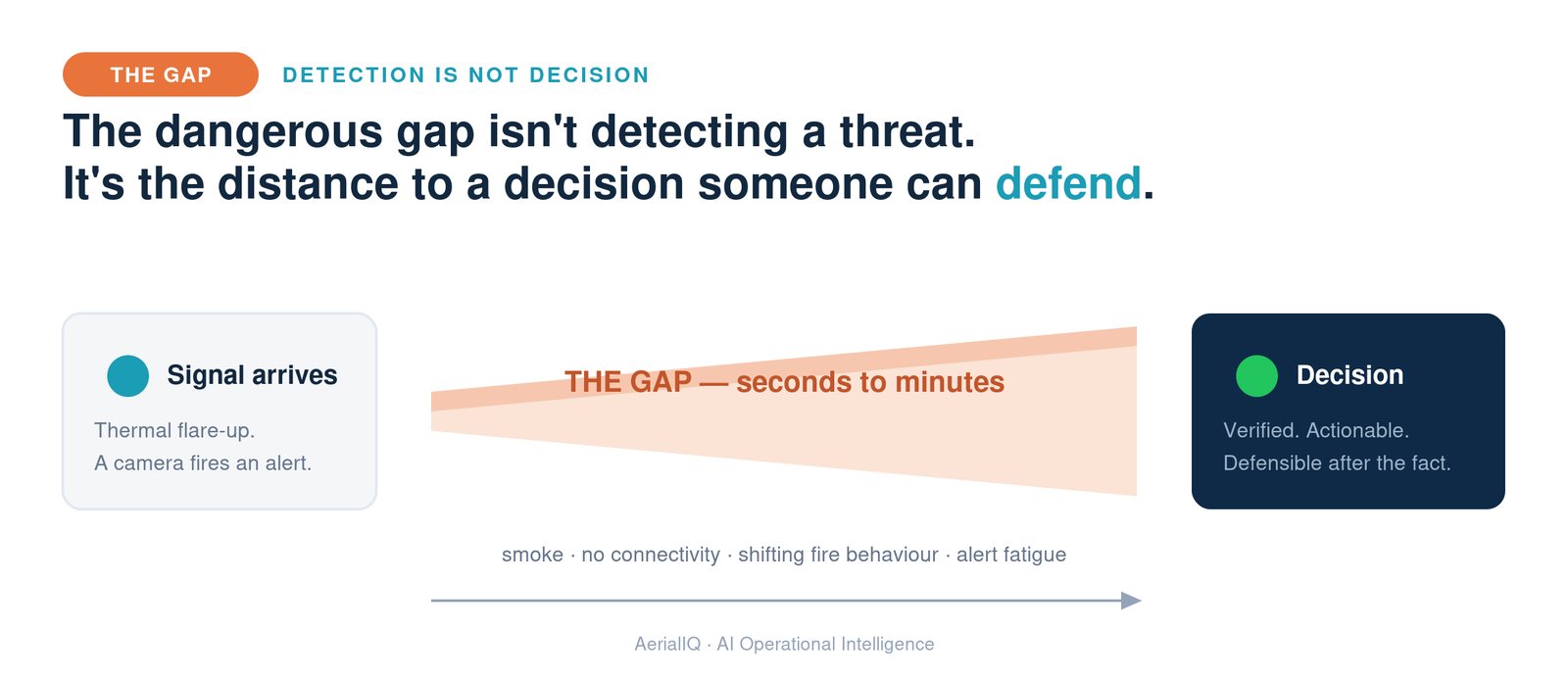
These were not detection failures. By the time a crew is on the ground, everyone knows there is a fire. The failures happen in the gap between a fire’s behaviour changing and a crew being able to see it, understand it, and act on it in time. That gap is measured in seconds. In an entrapment or burn-over, the mean flame length is between 10.6 and 15 metres, with recorded maxima approaching 46 metres.
This is the problem worth solving, and it tells you where the technology has to live. Not on a mountaintop. On the truck.
What today’s AI fire systems do well — and where they stop
The last few years have produced genuinely impressive fire-detection networks. Across the western United States and into parts of Australia and Canada, fixed AI camera networks now scan the horizon from towers and ridgelines — panoramic, pan-tilt-zoom optics watching tens of millions of acres for the first wisp of smoke. The largest of these networks detected hundreds of fires in 2025 before any member of the public called them in, frequently providing the first known alert, and newer thermal-capable cameras can pick up fire starts in the middle of the night.
This is the detection layer, and it works. But it shares three structural limits that matter enormously once a fire is large:
It watches from fixed infrastructure, far from the crews. It depends on connectivity back to a cloud model. And it answers one question — is there a fire? — when the people in the truck are already asking harder ones: is it about to reach us, where is it safe to go, and what just landed behind us?
A major bushfire breaks exactly the assumption these systems rely on. Communications are the first casualty. The Black Summer Royal Commission documented incompatible and failing communications across jurisdictions — in one case a NSW helicopter gathering situational awareness had to physically land because it could not talk to Queensland ground crews.
If your intelligence depends on a link to the cloud, your intelligence disappears at the exact moment the fireground turns dangerous. That is the case for moving the compute — and the reasoning — to the edge.
Why thermal + visual, together
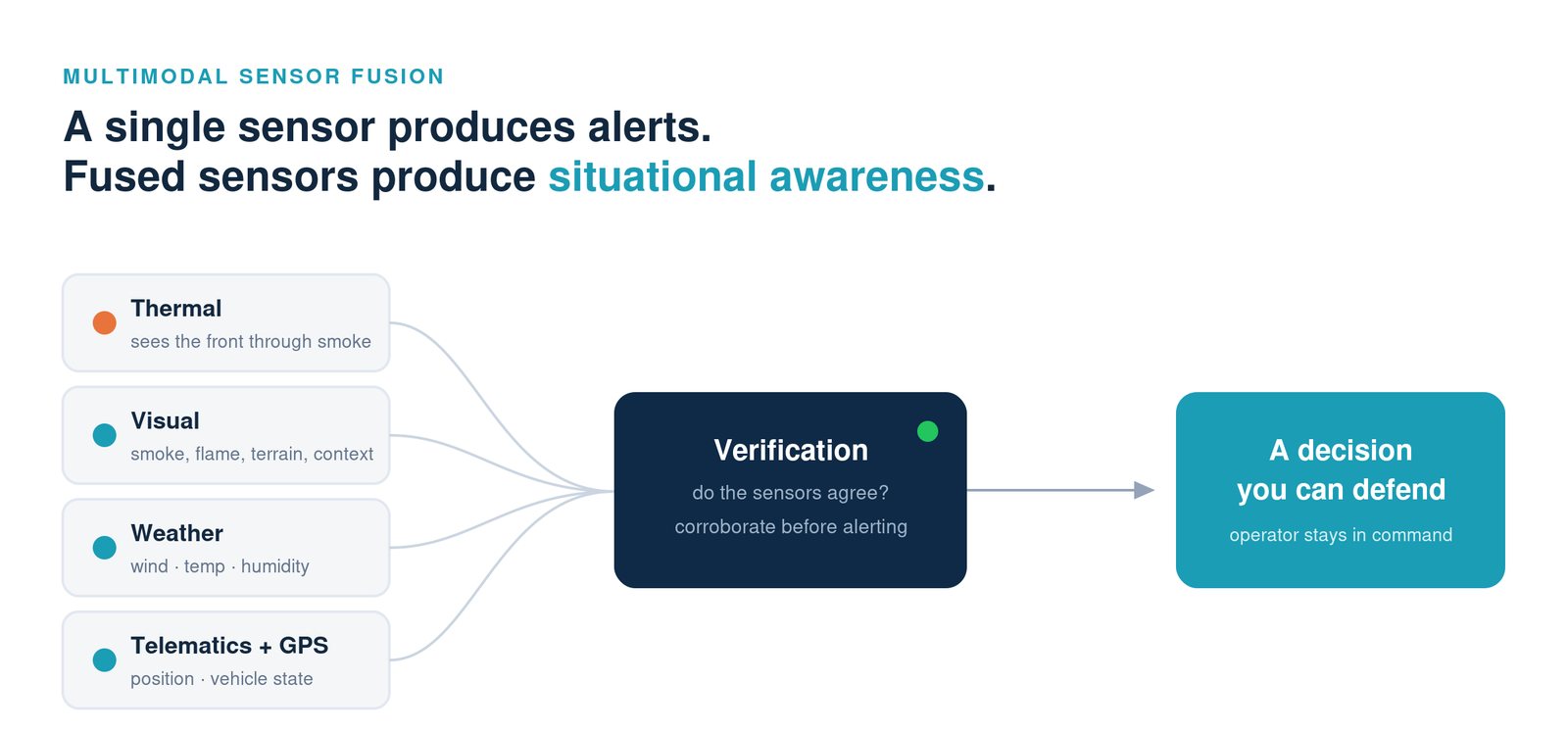
Thermal imaging earns its keep because infrared wavelengths are longer than visible light and pass through the carbon and water particles in smoke. A thermal sensor sees heat signatures — fire fronts, spot fires, people, vehicles — through smoke and darkness that are completely opaque to the eye. On a fireground that means seeing the front when you’re blind, finding hotspots and embers, and locating people.
But thermal alone is ambiguous. A hot rock, a running engine, and a flare-up can all look similar. Visual imagery adds context thermal can’t: smoke colour and movement, flame, vegetation, terrain. Fusing the two — and adding wind, temperature and humidity from an on-board weather sensor, plus the vehicle’s own location and telematics — is what turns a heat blob into a defensible read of what is happening and where it’s going. The fusion is the point. A single sensor produces alerts; fused sensors produce situational awareness.
The pressing use cases during a major bushfire
Surveying the field, six problems stand out where on-vehicle thermal + visual sensing changes what a crew can see and when. The first is the one I’d build for first.
1. Burnover and entrapment early warning (the hero use case) — The deadliest scenario on the fireground is a fire front that shifts faster than the crew can perceive — a wind change, a run upslope, a spot fire igniting between the crew and their escape route. Thermal sees the front’s rate and direction through smoke; fused with on-board wind data, an edge system can flag “the front is closing on your position and your egress route is heating up” while there is still time to move. This is the difference between a near-miss and a fatality.
2. Spot-fire detection behind and ahead of the line — Embers start new fires hundreds of metres to kilometres ahead of the front — and, dangerously, behind working crews. Thermal picks up an ignition through smoke before it produces visible flame, when it’s still small enough to deal with or, critically, before it cuts off a crew.
3. Through-smoke navigation and crew/asset tracking — In whiteout smoke, drivers lose the road and incident controllers lose track of where appliances are. Thermal restores a usable picture of terrain, vehicles and people in zero visibility.
4. Search and victim detection — Heat signatures of people and animals stand out against cooler or charred ground — for civilians who didn’t evacuate and for accounting for crew.
5. Mop-up and hidden-hotspot detection — After the front passes, preventing rekindle means finding smouldering stumps, root holes and logs that emit no visible smoke across thousands of hectares — a needle-in-a-haystack task that thermal makes tractable, on the ground or from the air.
6. Feeding the Common Operating Picture — Every truck becomes a moving sensor. When connectivity allows, fused reads sync upward to give the incident management team a live, ground-truthed map instead of a model and a phone tree.
The architecture: one edge node, three agents
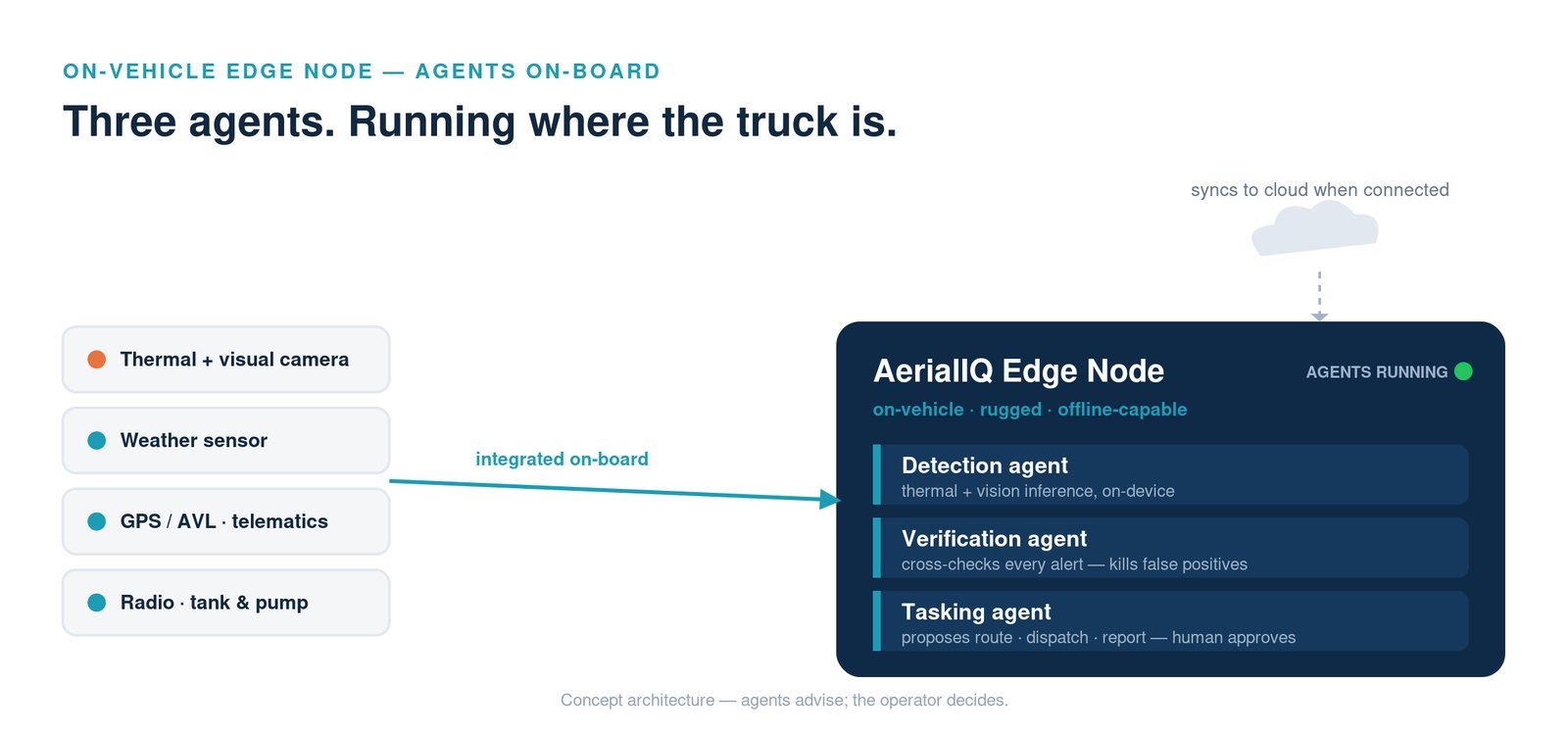
The concept that follows from all of this is the one shown in our on-vehicle deployment diagram: a single rugged, offline-capable edge node on the appliance, integrating the systems that are already there — thermal and visual cameras, weather sensor, GPS/AVL, vehicle telematics (CAN/J1939), radio and the tank-and-pump data — and running its reasoning locally. Three cooperating agents do the work.
A detection agent runs thermal and vision inference on-device, continuously, with no round-trip to the cloud.
A verification agent cross-checks every candidate alert against the other sensors — is the heat source corroborated by smoke in the visual feed, consistent with the wind, moving like a fire and not like a hot engine? This is the agent that exists to kill false positives, because on a fireground a system that cries wolf is worse than no system at all.
A tasking agent turns a verified read into something usable: a recommended safer route, a drafted situation report, a flagged egress risk — proposed to the crew and the incident controller, never executed over their heads.
That last distinction is deliberate and non-negotiable. These agents advise; people decide. The crew commander and the incident controller stay in command at every step. When the link is available, the node syncs to the cloud and contributes to the wider picture; when the link is gone — which is precisely when a major fire is at its worst — it keeps working alone. (This is a concept architecture; it describes how the system is designed to work, not a claim that every element is fielded today.)
Where it’s heading: multimodal fusion and explainability
Two threads in the 2026 research literature tell you where edge fire intelligence is going, and both reinforce the same idea.
The first is deeper multimodal sensor fusion. Recent work fuses RGB imagery with synthetically generated thermal-style representations across multiple model backbones, combines smoke imagery with a dozen environmental risk factors such as temperature and wind to reach ~93% prediction accuracy, and fuses wide-area radar with UAV optical and thermal feeds for all-weather surveillance. The direction is clear: no single sensor is trusted on its own; confidence comes from agreement across modalities. That is exactly what a verification agent is for.
The second is explainability — the move from systems that emit an alert to systems that can answer “why did you flag this?” Researchers are integrating vision-language models that translate raw sensor data into human-readable insight, and applying interpretability methods like SHAP to make wildfire risk decisions transparent rather than opaque. For anyone who has to defend a decision afterward — at an inquiry, in a coronial process, to the family of a crew member — this is not a nice-to-have. A flag a commander can’t interrogate is a flag they can’t fully trust, and shouldn’t. The explanation is the chain of evidence.
Put those two threads together and you get the design principle for edge fire intelligence: fuse everything you can sense, verify before you alert, and be able to show your reasoning. Detection was never the hard part. Turning a signal into a decision a commander can act on in seconds — and defend later — always was.
The fireground is the hardest place to run AI: no connectivity, life-and-death stakes, no second take. Which is exactly why it’s the place the technology has to prove it belongs — on the truck, when the link drops, the decision can’t.
References
Honouring the fallen volunteer firefighters, five years on — About Regional: aboutregional.com.au
Improving firefighter tenability during entrapment and burnover — ECU / Safety Science: ro.ecu.edu.au
Black Summer Royal Commission, communications findings — AirMed&Rescue: airmedandrescue.com
No power, no phone, no radio: why comms dropped out — The Conversation: theconversation.com
AI wildfire-detection camera networks, 2025 — WVIA/NPR: wvia.org · Scientific American: scientificamerican.com
Thermal imaging in firefighting — WFCA: wfca.com · FireRescue1: firerescue1.com
Thermal drones for hotspot detection and mop-up — Canberra Times: canberratimes.com.au
Multimodal RGB + pseudo-thermal wildfire classification — Fire, 2026: doi.org/10.3390/fire9030109
SAR + UAV optical/thermal fusion with vision-language insight — Scientific Reports, 2025: nature.com
Explainable AI for wildfire detection and management — Springer Discover AI, 2026: link.springer.com