The next AI won’t answer your questions. It’ll run your operations — with you in command
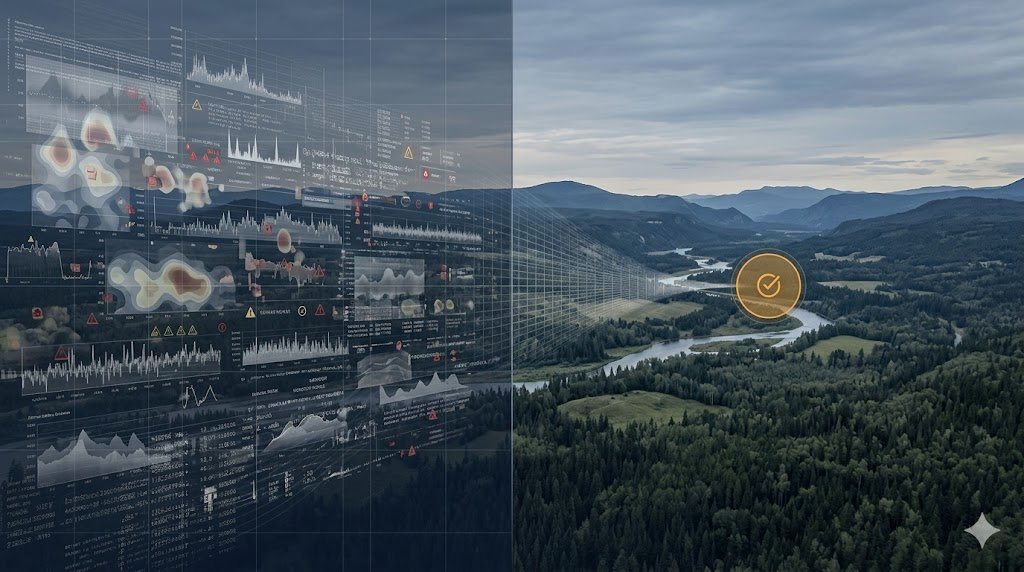
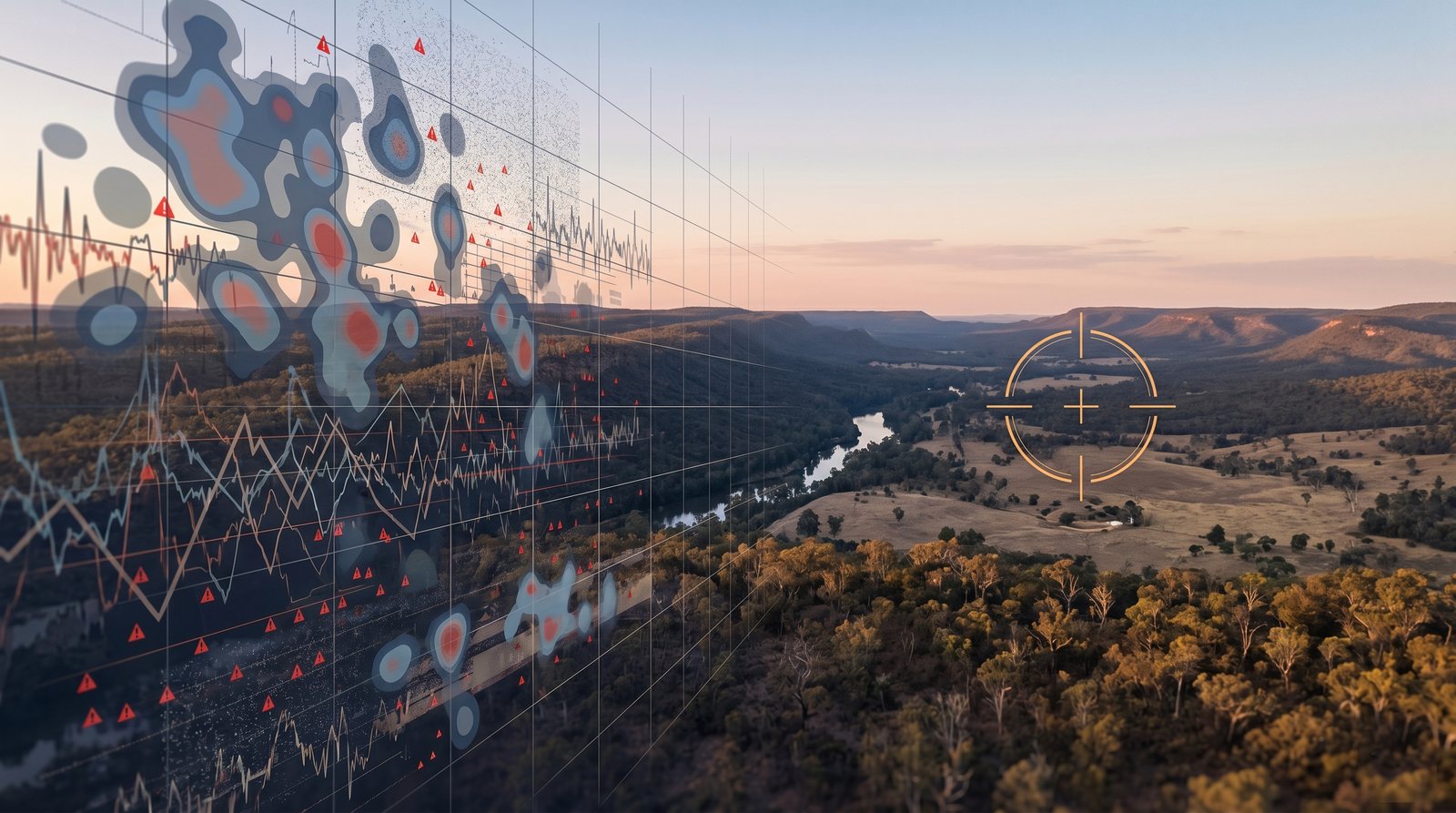
AI operational intelligence turning a flood of field data into a single verified point of interest.
Almost every AI you’ve met lives in a chat box. You type a question, it types back. Useful. Also the least interesting thing AI is about to do.
Because the version that matters for people who manage land, infrastructure, and risk doesn’t wait to be asked. It sits between a field signal and a decision — watching, reasoning, and recommending — while a human stays in command.
That’s the AI we’re building at Edgegenix. Not a chatbot. An operational intelligence layer for the physical world.
Here’s why it has to exist.
We made seeing cheap. We forgot to make deciding easy.
Somewhere across the landscape you’re responsible for — and it might be 200,000 hectares — something just changed.
A camera caught smoke. Or it caught a low cloud. A sensor spiked. Or it glitched. A satellite pass shows a patch of ground that looks wrong. Maybe it is. Maybe it’s last week’s image and a shadow.
You have minutes to decide whether to move people, machines, and money. Overreact and you’ve burned trust and budget on a false alarm. Wait too long and the thing you were watching becomes the thing on the news. Either way, you’ll be explaining the call for months.
The hard part of the job was never seeing. It’s that moment.
And the flood of new data has made it harder, not easier. Drones, sensors, cameras, satellites — all cheaper every year, all pouring feeds onto the same screen. IBM estimates as much as 90% of sensor-generated data is never analysed at all. It’s collected, stored, and quietly ignored, because there was never a human with enough hours to look at it.
So the one signal that matters ends up buried under a hundred that don’t. That’s alert fatigue — the quiet reason good operators miss real things. Not because they weren’t looking. Because everything was shouting at once and nothing told them where to look.
The cost of getting that moment wrong isn’t abstract, and you don’t have to look overseas to see it. Australia’s Black Summer bushfires of 2019–20 are estimated to have caused around A$100 billion in total economic loss — the costliest natural disaster in the country’s history. Two years later, the Auckland floods and Cyclone Gabrielle cost New Zealand an estimated NZ$14.5 billion, the most expensive cyclone ever recorded in the Southern Hemisphere. And the most damaging events aren’t always the biggest on a map — often it’s a small change, in the wrong place, missed for a little too long.
A system that shows you everything and decides nothing isn’t situational awareness. It’s homework.
What Edgegenix actually does
Edgegenix connects your live field signals to your organisation’s own knowledge, and puts sovereign AI agents to work on them — detecting risk, reasoning through context, and recommending action.
In plain terms, the agents do four things a wall of screens never could:
Connect everything. Drones, sensors, cameras, satellites, weather, GIS, incident reports — pulled into one live operating picture instead of five systems you stitch together in your head.
Add context. A signal means nothing on its own. The agents tie it to the asset, the boundary, the corridor, the history — so a hot pixel becomes “thermal anomaly, 400m from the substation, trending the wrong way.”
Reason and verify. They check signals at the point of capture and score their own confidence, so what reaches you is something you can trust — not a raw alert that’s just as likely a shadow as a fire.
Recommend, with evidence. Not just “something’s wrong,” but “here’s what changed, here’s why it matters, and here’s the media and data that prove it.”
And then the agents stop. They don’t dispatch a crew, close a valve, or commit a dollar. They hand you a verified, prioritised picture and a recommendation you can act on — and you make the call.
That line is the whole philosophy: the AI runs the picture; the human runs the decision. “Sovereign” matters here too — the intelligence works inside your control and your jurisdiction, not someone else’s cloud. Because when you stand in front of a board, a regulator, or a community, “the system decided” is not an answer anyone accepts. “I could see exactly what was happening, and here’s the evidence for why I acted” — that one holds.
The same problem, every landscape
It’s tempting to tell this story with bushfire, because the stakes are vivid. But fire is just the loudest version of a problem that shows up wherever land and infrastructure need watching.
A flood team trying to see where water is moving and what’s exposed first. An agriculture or biosecurity manager catching pest risk early, before it spreads. A land or asset manager spotting encroachment or unauthorised change before it becomes a problem.
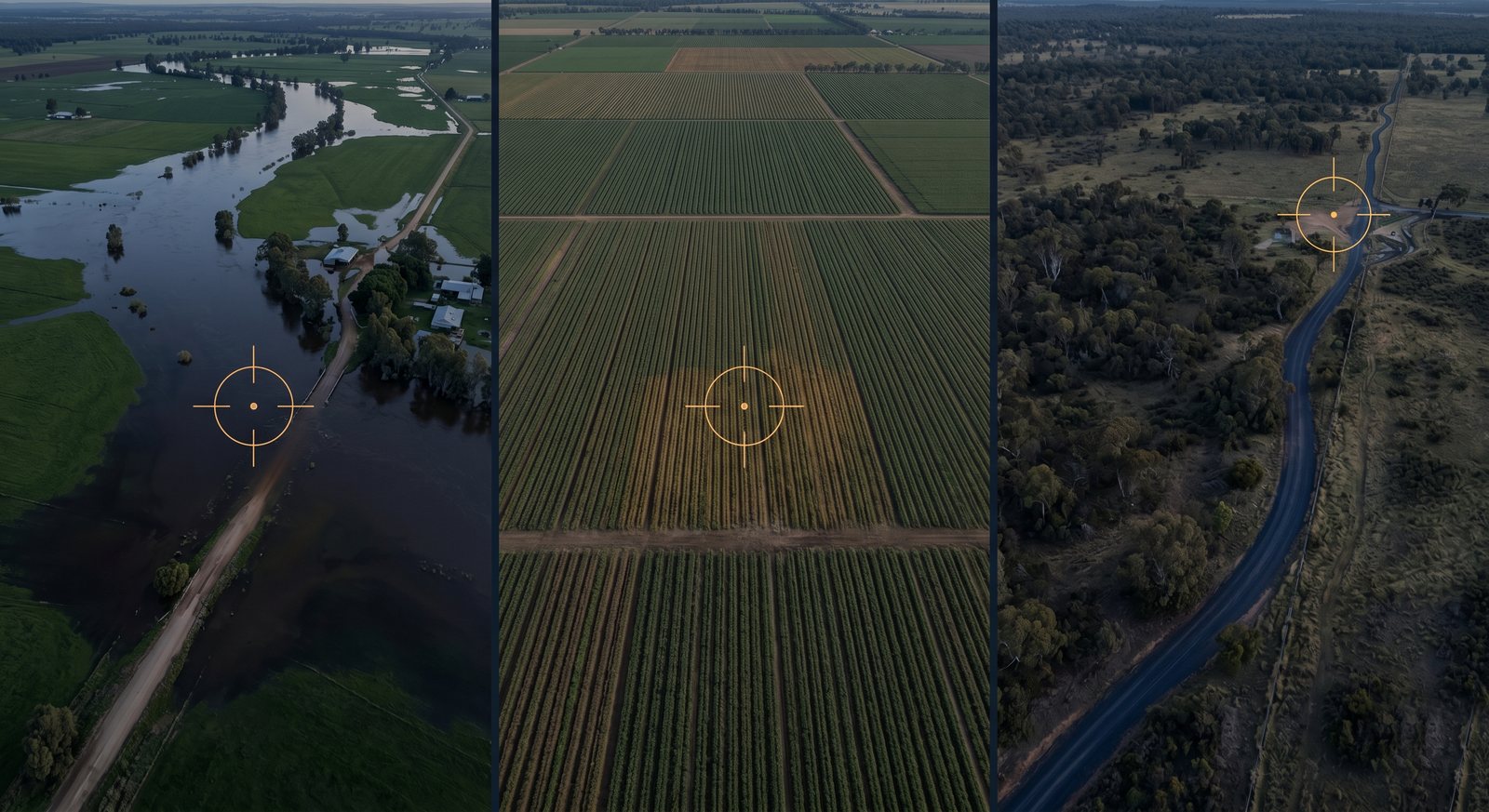
One AI-marked point of interest across three landscapes — flood, farmland, and bushland — a single intelligence layer applied to different operational problems.
Different sectors. Same moment. Something changed, the clock is running, and a human has to make a call they can defend. That problem doesn’t care what industry you’re in — and neither does the answer. Edgegenix is drone-agnostic and never requires our hardware; it plugs into what you already fly and already own.
Why now
The pieces only just lined up. Cameras, drones and sensors got cheap. AI got good enough to reason about messy field data in real time instead of in a data centre a day later. And operators finally have so much data that the old way — one person manually making sense of all of it — quietly stopped working.
Seeing was the last decade’s problem. Deciding is this one’s. And for the first time, the picture itself can do some of that work — without ever taking your hands off the controls.
So the next time something on your land or your network needs a call, ask one question: did your AI just show you everything and wait? Or did it stand between the signal and the decision, and help you act?
We think operators deserve the second one. That’s what we’re building.
If you’d like to follow our journey, join the Edgegenix community on Discord.
Sources for the figures above: IBM (sensor-generated data never analysed); University of Sydney / WWF-Australia and Royal Commission estimates (Black Summer 2019–20 total economic loss ~A$100bn); New Zealand Treasury / ICNZ (Auckland floods & Cyclone Gabrielle, ~NZ$14.5bn total damage).